
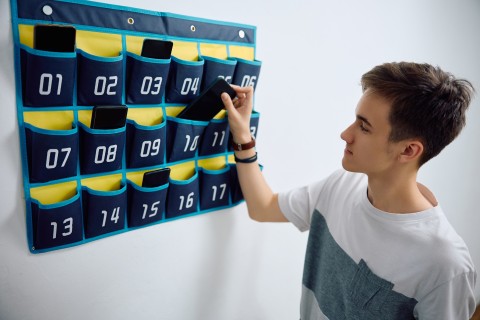
Cell phones and other personal devices have become a constant presence in schools, raising concerns about disruptions to student learning. As a result, lawmakers in Kansas, Missouri, and other states across the country are taking a closer look at policies that limit student access to devices during the school day.
The purpose of these laws is to protect instructional time and enhance the learning environment. While local bans exist, a statewide policy would set a consistent standard across Kansas, allowing school districts flexibility in the implementation of this ban.
In January 2026, a bipartisan coalition of Kansas legislators introduced S.B. 302 and H.B. 2421, both of which require districts to restrict personal electronic device use during instructional time (with other provisions). Missouri enacted a cell phone ban during the 2025 legislative session.
This post covers what these policies look like in practice, what research suggests, how states approach them, key design choices that shape implementation, and a plain-language summary brief of the Kansas proposals.
Frequently Asked Questions
What does this look like in practice?
Most policies don’t ban students from having a phone. They restrict using it during the school day — typically requiring devices to be off, put away, and not accessible during instructional time (and sometimes bell-to-bell).
Why is this happening now?
Schools are responding to a simple reality: phones are a constant source of distraction and conflict. Policymakers and educators are looking for clearer, more consistent expectations that protect instructional time and improve the learning environment.
When can students use devices (if ever)?
That depends on the policy. Some models allow use before/after school or during lunch, while others are bell-to-bell. Most include limited exceptions for teacher-directed instructional use.
How do parents reach students? What about emergencies?
Schools typically direct families to contact the main office (or nurse/administrator) during the day. In emergencies, schools rely on established safety protocols and communication systems; a phone policy does not replace emergency plans. Additionally, both bills introduced in Kansas require schools to have a designated form of communication between students and parents.
What about medical needs, IEPs, or 504 plans?
Most policies include exceptions for documented medical needs and required accommodations. The goal is to reduce distraction while still meeting students’ health and disability-related needs.
How is it enforced without turning teachers into phone police?
Effective policies set clear expectations and make enforcement school- or district-led, not dependent on individual teachers. Many schools use simple routines (devices stored away, consistent consequences) so teachers can focus on instruction instead of constant monitoring.
What states have these policies? How do they differ?
According to an Edweek policy tracker, at least 33 states and D.C. now require school districts to ban or restrict student cellphone use in schools (as of January 2026).
The biggest dividing line between state policies is when restrictions apply to device use:
- 23 states and D.C. restrict devices for the entire school day. This approach is often referred to as a “bell-to-bell” cellphone ban. Some states with this approach stipulate this policy for only certain grades. For instance, Florida has a bell-to-bell restriction for students K-8; high school students are only restricted during instructional time.
- 9 states restrict devices during “instructional time,” and let students use devices during lunch, passing periods, and before or after school.
- Minnesota and West Virginia both address student device use but leave most decisions to local districts. Minnesota simply requires districts to adopt a cell phone policy without prescribing the details. West Virginia requires local boards to either ban cell phones on school property or require students to store them for the entire school day
There is a lot of variation on other policy design choices: which devices are covered (phones only vs. broader personal devices), what exceptions exist, and how much is left to districts to decide. The table below breaks down the key design choices that shape how a “cell phone ban” works in practice.
| Design choice | Option A | Option B | Option C |
| When device is restricted | Bell-to-bell | Instructional time | Local discretion |
| Devices covered by policy | Phones only | Phones + wearables | Broad “personal device” definition |
| Who decides “how” device is banned | State mandate | District chooses | Local discretion |
| Storage method | Specifically required | Suggested | Optional |
| Enforcement | State-prescribed enforcement steps and consequences | District policy sets procedures | Administrator discretion |
| Exceptions | Only medical + emergency needs | Medical, IEPs, teacher-discretion | State minimum + local discretion |
What does research say about cell phone bans?
Research suggests that when schools seriously limit phone use during the school day, students are less distracted and academic performance can improve slightly. Some studies also indicate the biggest gains may show up among students who were already struggling academically.
While evidence is still emerging, one rigorous evaluation of a large Florida district suggests effects may take time, with early implementation friction (including discipline) and test score gains showing up later, alongside improved attendance.
Research also suggests bans reliably reduce in-class distraction and can improve day-to-day learning conditions, but the broader outcome story is more mixed: evidence on wellbeing and mental health improvements from school phone policies alone is weak.
Research reviews also note the evidence base is still limited and inconsistent, so results should be interpreted cautiously and likely depend heavily on implementation.
What are the proposed bills?
Kansas lawmakers have introduced legislation to limit student device use during the school day. Originally, Senate Education Committee members introduced S.B. 302. House Education Committee members have also introduced a similar proposal, H.B. 2421. The two bills share the same core framework: a bell-to-bell restriction on student use of personal electronic communication devices and a prohibition on private/direct staff–student communication via social media for official school purposes, with schools able to approve platforms for one-way public communications.
The following brief compares Kansas’s two main student device proposals and highlights what they have in common and where they differ. It provides a quick, plain-language overview of each bill’s core requirements, key definitions, and the handful of meaningful differences that could affect implementation.